Bearing the fruits of the Holy Spirit in our lives

image_pdfimage_print

Rev’d Peter Balabanski

Pentecost – Acts 2 1-21 Ps 104 26-36 1 Cor 12 4-13 Jn 20 19-23

We don’t talk much about the Holy Spirit. We talk about what Jesus did and said, we talk about Christian values like justice, mercy and faith. We talk about scripture, ethics – lots of things, but we don’t say much about how the Holy Spirit fits in. So how would you and I recognise the Holy Spirit if we bumped into each other? If we’re not sure we could recognise the Spirit, how might we learn to do so reliably?

They say you can never quite catch the Holy Spirit, but you can always tell where she’s been. So maybe that’s a good place to start; like a careful tracker, let’s look for signs that she’s been with us. Those tracks will leave these characteristic marks in people: love and joy, peace and patience, kindness, generosity, faithfulness, gentleness, and self-control. Gal 5:22-23

I’ve comer across clear tracks this week talking with someone who is generous enough to feel deep, true gratitude, despite the terrible suffering their life has brought them. Gratitude is a generous gift to everyone around such a person. And then there was another person who’s been terribly wronged and injured, but who doesn’t seek revenge, but rather chooses the healing path of forgiveness and love. These are clear tracks to show that the Holy Spirit is at work in these people, and through them, offering astonishing gifts to all of us.

These people have been free to make their own choices. If their choices tend towards these things – love and joy, peace and patience, kindness, generosity, faithfulness, gentleness, and self-control – then we see evidence of the Spirit’s involvement. But they are choices; always. The choice is to follow the guidance of the Spirit calling from within us, or to choose a different path. It’s often a costly, tentative choice. And often too, one we can only really evaluate in hindsight. You may know how the poet, Robert Frost, ended his poem, The road not taken, ‘I chose the path less travelled by, and that has made all the difference.’ There’s a huge difference in a life that chooses the trajectory of the Spirit towards love and joy, peace and patience – so different from a life that turns its back on kindness, generosity, faithfulness, gentleness and self-control.

In today’s epistle, Paul writes about this sort of choice to the church in Corinth. They were a church whose gatherings were plagued by issues of class distinction and spiritual one-upmanship. Paul urges them stop this. It would have been a very counter-cultural choice for them to make in their cosmopolitan, nouveau-rich city. On the subject of spiritual one-upmanship, Paul argues that spiritual growth isn’t about the ambition or importance of the person manifesting a spiritual gift. Spiritual gifts are given for the common good; not as a status symbol. The Holy Spirit is the source of all spiritual gifts; and they are given ‘as the Spirit chooses’.

There are two other things Paul writes about in today’s epistle reading that help us learn how to follow the leading of the Holy Spirit: first about us being the body of Christ, and second about our baptism.

First, as the body of Christ, our call is to be filled with the Spirit, just as Jesus was. Rowan Williams writes about how Jesus was so utterly filled with the Spirit of God that he was the physical embodiment of the Wisdom, the Word and the Love of God. It meant all he did and said brought people face to face with God. And that’s our calling too; we are now Christ’s body, his hands, his feet, and his voice for the world now.

Paul obviously felt that the Corinthian church had work to do on that front. We do too! It’s a process for each of us as individuals and all of us as a congregation, as a denomination and as the national and worldwide Church – are we embodying Jesus? Does the world encounter the Holy Spirit through us? The opposite or a counterfeit can be dreadful! (The graffiti on the sacred Mt Beerwah QLD https://www.abc.net.au/news/2023-05-26/mt-beerwah-vandalism/102397546 saying ‘Jesus saves, just ask him’) Whether it was a Christian or someone pretending to be doesn’t matter: it’s the harm done that is so shocking.

The process of developing the gifts of the Holy Spirit for each one of us is inaugurated at our baptism – and that’s the other thing Paul mentioned. Our baptism is new birth into resurrection life. It’s when we acknowledge that the Holy Spirit has come to live within us, at the centre of our being. We can encourage each other to follow the Spirit’s guidance within us; recognise and name the Spirit’s fruits when we see them.

What’s the Spirit doing in there, inside us? Paul writes that the Holy Spirit, living in us, perceives the deepest needs of our hearts – needs we may not yet know of; needs we have no words to express. From inside us, the Spirit offers those needs in prayer for us; offers them in sighs and groans deeper than words. Rom 8.26

Our part in this prayer – both as individuals and as a congregation – is to learn to hear what’s being prayed for, and willingly let ourselves be healed, renewed, and made whole; to willingly become Spirit centered like Jesus. The vision of the Spirit-filled Jesus before us is our role model. He beckons us to follow him; to become more like him; to embody more truly God’s wisdom and love; you and me, and all of us together.

Let’s pray. Lord Jesus, for the sake of the world you love, help us to be attentive to the Holy Spirit, and bear the fruits of the Spirit in our lives: love and joy, peace and patience, kindness, generosity, faithfulness, gentleness, and self-control. Amen

Jesus’ Great High Priestly Prayer

image_pdfimage_print

Rev’d Peter Balabanski

Easter 7 A – Ac 1.6-14, Ps 68.1–10, 32–35, Ist Pt 5, Jn 17.1–11

The Week of Prayer for Christian Unity

Holy Father, protect them in your Name that you have given me, so that they may be one, as we are one. Jn 17.11b. John 17 begins each year’s international Week of Prayer for Christian unity – in the lead-up to the first Christian Pentecost.

Today’s gospel reading is the beginning of a passage that the Church calls Jesus’ Great High Priestly Prayer. Here we see Jesus as priest, praying for those in his care that we may be one. What do we make of Jesus as our Great High Priest – which means someone who intercedes with God on our behalf? How do we take hold of that? I’m used to encountering this idea of prayer in churches where saints and angels are also asked to pray for us.

I’ve had conversations over many years with people who view that sort of prayer with deep suspicion. They see it more as a sort of superstitious lobbying than prayer. They feel that ‘real prayer’ should be between just me and God – direct, with no intermediaries. They feel that teaching people to pray by asking Mary or Jude or Christopher or anyone else to pray for us is some sort of heresy. But then I also hear of God answering just such indirect prayers in quite spectacular ways.

And then there are plenty of faithful Christians who look at us Prayer-Book Anglicans with at least one eyebrow raised: Can’t you pray unless it’s written down in front of you? they ask. What sort of prayer is that? Where’s the spontaneity? How do you expect the Spirit to find room to move if your prayers have all been written down years in advance? Providentially, the Holy Spirit is astonishingly versatile – not constrained at all by time; God is very broad minded; and Jesus is welcoming of the most unlikely.

You might think it’s pretty odd for me to be talking about all these differences between Christians on this first day of the Week of Prayer for Christian Unity. No lobbyist worth their salt should do that. But I think it’s really important to enter this week in the clear knowledge that we are all different, and yet, we are all alike loved by God. It’s really important that we don’t confuse a week of prayer for Christian unity with hopes of a week of prayer for Christian uniformity. The two things are not the same. If we try to define unity as uniformity, we are violating something that is fundamental to our created being, and to all our different ways of belonging to Jesus.

Story: The week of prayer for Christian unity in Jerusalem.

Something that’s absolutely basic to the faith of all varieties of Christians is that Jesus did what he did for us before we had taken a single step towards him. So no-one was out in front; no-one stood out as being ‘right’.

St Paul puts it this way in Romans 5.6-8

… while we were still weak, at the right time Christ died for the ungodly. 7 Indeed, rarely will anyone die for a righteous person—though perhaps for a good person someone might actually dare to die. 8 But God proves his love for us in that while we still were sinners Christ died for us.

What Paul is saying is that our relationship with God doesn’t depend on whether or not we’ve got our theology straight. Paul – once a persecutor of the Church himself – learned that our relationship with God depends purely and simply on one thing; the gracious love of Jesus. And that goes for everyone, even persecutors of Christians.

None of us can say another Christian’s way of responding to God’s is unacceptable to God. It’s up to God to decide. And frankly, what God is gracious enough to accept is always likely to astonish us. That is, quite literally, our saving grace.

Jesus prayed that we may be one. That prayer is the reason for the week of prayer for Christian Unity. The first unity we need to recall is that despite our squabbles and failings, we all stand equal before God – all alike, loved by God. And the proof of this is Jesus’s coming for our sake before any of us knew him. So much for our partisan, tribal disunity. That’s a different world. Our unity is in the welcoming, all-embracing call of Jesus.

But then what? This is where the link with prayer comes in this Week of Prayer for Christian Unity.

Prayer opens us to the in-breaking of the Holy Spirit. She will receive our multitudes of apparently conflicting various yearnings, and somehow weave that chaotic variety and contradictions into a blessing that is whole and unified – a blessing which can empower us to be Christ’s blessed presence in this world. This comes through the grace of unity – then effect of Jesus’ prayer – and our response.

Yes; we have agency in this. Sr Joan Chittister put it this way. She said that …prayer is not something given to us to change the world. It is meant to change us, so that we can change the world. Prayer is something given to us so that we can change the world.

I pray that we may join our Lord Jesus in his prayer that we may be one. May we overlook and even celebrate our variety – because that doesn’t seem to bother Him at all – and so let the world know that no-one can be separated from the love of God, in Christ Jesus, our Lord. Amen

Our calling to be part of Christ’s grace and love for the world

image_pdfimage_print

Rev’d Peter Balabanski

Easter 6 A – Ac17.22-31, Ps 66.7-19, Ist Pt 3.8-22, Jn 14.15-21

The story of the altar to the unknown God reminds me of the first thing you see when you go into Westminster Abbey. It’s the Tomb of the Unknown Soldier; one of the most striking of the 170 odd monuments that you can see there. It’s just inside the west door, right in the middle of the aisle, surrounded by a tiny hedge of brilliant red poppies or other flowers. The flowers set it apart. So does the inscription – not just what it says, but also its brand new appearance. The lettering on this stone is as crisp as it was on the day it was unveiled – Armistice Day 1920. Other tombs set in the floor of the abbey are barely legible; worn out by the feet of millions of pilgrims. But no-one walks on this one. Even last week’s coronation processions detoured around it.

We have a memorial to the unknown God by the entrance to this church. The centre window above the baptistery remembers today’s story of Paul talking to the philosophers on the Areopagus about an altar he’d discovered in Athens; an altar dedicated to ‘the unknown God’. The Unknown Soldier and the Unknown God – the Unknown Soldier represents an ordinary person – it could be you or me. The unknown God could be our God; somehow bound to us by the same sense of mixed familiarity and mystery. No arcane knowledge or ritual stands between us and the possibility that this God might just be our God – yours, mine, everyone’s.

The Unknown Soldier and the Unknown God could be nothing to us, yet somehow they represent something common to all of us. Somehow they are present to us, as they may be to everyone else too. In today’s gospel, Jesus touches on this commonality between us. He’s in the upper room with his friends – where we spent time with them on Maundy Thursday – and he’s just told them – us – that he’s going away. But two things will protect us from losing our connection with him; first, keeping his commandments – particularly the new commandment he had just given to love each other as he loves us – and second, the gift to each of us of the Holy Spirit. These two things – love and unity – will work together to see us embody and honour Jesus who will soon be invisible to them, as he is to us.

Our two monuments to Jesus are our love and our unity as people blessed by the Spirit’s presence. They are sacred. The altar to the Unknown God, and the tomb of the Unknown Soldier – express these sacred gifts in a similar way. They each speak of those who’ve been like Jesus for us; blessing and defending us even before we knew of them – before we were born. They also say there’s something sacred about each of us; they assert our commonality through the mystery of our connection to a God and a Soldier who were unknown to us.

Undeserved grace is the name of this connection; the Soldier, the Unknown God, Jesus – they’ve taken us on trust; they’ve given us the benediction of their trust, and by doing that, they’ve somehow declared us to be their family. And they’ve called us to be that family for each other. Grace believes in us. Grace takes us on trust.

Christians proclaim this grace to be perfectly expressed in Jesus. His acceptance and support were available to us before we’d ever been, and he still offers us free acceptance no matter how – or how often – we let his trust down. When someone trusts you to be a better person than you think you really are, it’s lovely! When you know there’s someone who always thinks the best of you, it helps you do just that little bit better. You want to vindicate their trust; make them glad they trusted you. This grace is something we experience as healing. It’s much more than physical healing. Something much deeper than what we ask is given to us. Grace can make us whole.

What do the Unknown God and the Unknown Soldier have to do with all this? They’re unknown to us, but all the same, we sense deep down that they’ve done something for us. They have a mysterious friendship with us, and everyone around us. These Unknowns are pictures – symbols of an invisible friend whose identity we discover through countless little meetings and experiences; a secret friend who, we ultimately discover, is with us – who is in us – just as Jesus said he would be.

Jn 14.18 I will not leave you orphaned; I am coming to you.  19 In a little while the world will no longer see me, but you will see me; because I live, you also will live. 20 On that day you will know that I am in my Father, and you in me, and I in you.

May we respond to our calling to be part of the connective tissue of Christ’s grace and love for the world? It may be that we’ll serve anonymously – unknown. But that seems fitting in a in a world where the unknown poor and downtrodden cry out to be heard and known. Amen

John – Apostle and Evangelist

image_pdfimage_print

Rev’d Peter Balabanski

John – Apostle and Evangelist – Prov 8 22-31, Ps 97 1, Jn 1 1-15, Jn 20 2-8

In 2012, Vicky and I visited the site of Ephesus; a great city which had stood on the Mediterranean coast of modern-day Türkiye. In Jesus’ time, Ephesus boasted the Temple of Artemis, one of the seven wonders of the ancient world. (See Acts 19 for Paul’s encounter with the Artemis cult) Near Ephesus we saw two sites revered as the burial places of Mary, Jesus’ mother, and John, the beloved disciple, Apostle and Evangelist. You’ll recall how on the Cross, Jesus gave them to each other as mother and son. (Jn 19.26) So it makes sense to find their graves close to each other.

Living in Ephesus, John inhabited two cultures, like we do today. John straddled the Jewish traditions of his homeland, and the Græco-Roman ways of Asia Minor. We live a similar dual life. We inhabit the deeply symbolic expressions and traditions of our Christian faith, and also a cosmopolitan western culture that has practically no idea what we’re about. We’re viewed with anything from good-humoured tolerance of our peculiarities right through to deep resentment and contempt. It’s in this environment, and with our self-imposed constraints, that we bear witness to Jesus. What might our patron John teach us about doing this?

John has left us plenty of material; his Gospel, three letters, and possibly also the Book of Revelation. A major theme in his writing –one which we encounter today – is seeing and believing. The central moment in our Gospel today was that the beloved disciple saw and believed. Likewise, in his first letter, we heard him say …1 2 this [eternal] life was revealed, and we have seen it and testify to it, and declare to you the eternal life that was with the Father and was revealed to us. So being an eyewitness to what Jesus reveals, seeing, believing and bearing witness, is John’s life’s work: Apostle – sent out, and Evangelist – bearer of the Good News.

But what’s that to us? We’re not eyewitnesses. The Melbourne Jesuit Bible scholar, Brendan Byrne argues (JSNT 23 pp 83-97) that in today’s Gospel, after that running race to the tomb with Peter, we should be careful to remember that what they saw there was an empty tomb; the linen wrappings lying there, 7 and the cloth that had been on Jesus’ head, not lying with the linen wrappings but rolled up in a place by itself. They didn’t see the resurrected Jesus – not yet. But even so, the beloved disciple saw and believed. Peter wouldn’t get it for some time yet. But our John did.

Later in this chapter, when Thomas received the proof of his own eyes and hands to enable him to believe, (20.27) Jesus pointedly blesses those – us – who have not seen, and yet have come to believe. (20 29)

So today, John who doesn’t see, yet believes, just like us – John calls us to risk trusting our inner sight. The theme that unites this whole chapter is seeing and believing. And we are called to look through the eyes of the people in this story.

The beloved disciple outran Peter. John got to the tomb first. But whether he meant to show deference to his older friend, or he was overcome by a moment of shocked paralysis after glancing inside at the scene which greeted them, in those few moments, something huge happened in John.

It wasn’t like him to hold back. He’d gone with Jesus into the courtyard of the High Priest while Peter stayed outside, (18.15) he’d stood by Jesus with Jesus’ mother and the other Marys at the foot of the Cross, (19.25-26) while Peter was nowhere to be seen.

So this pause at the mouth of the tomb was uncharacteristic for John. Something huge was happening inside the beloved disciple. And the call of the Gospel that he and his community have left us is to see through his eyes, let the scene do its work in us, and together with him, move deeper into faith. Whatever it was that he saw conquered on that early morning stands before us too. For us as for John, our way is into the gift – not the work – the gift of deeper faith.

The Welsh poet and Anglican priest, Ronald Stuart Thomas described this in the final lines from his poem, The Answer.

…There have been times when

after long on my knees in a cold chancel, a stone has rolled

from my mind, and I have looked

in and seen the old questions lie

folded and in a place

by themselves, like the piled

graveclothes of love’s risen body.

John, our patron invites us to believe deeper into Christ. And his reason is what we heard in his letter this morning. He tells what he has seen and heard so that others may enter this fellowship with the Father and with his Son, Jesus Christ – that others may share such joy.

Just like John, we live in two contrasting cultures. And thanks to John, we see through his eyes what it means to live that life in company with the Jesus he knows: Jesus who celebrates with us (Jn 2.1-11), Jesus who cleanses us (2.13-22), Jesus who brings us to new birth (3.1-21), Jesus who crosses cultural divides, (4.1-42) who puts religious taboos in their place and stands with the lost and needy.(4.46–5.18) John has seen and told about Jesus the creator who feeds the hungry (6.1-14), about Jesus the healer, (Ch 9) about his compassion,(8.1-11, 11.28-43). John had told us that in the shadows of the spiritual night, Jesus the Good Shepherd lies across the gateway of our souls; a living gate, strong in the face of despair and even death itself. (10.7-10)

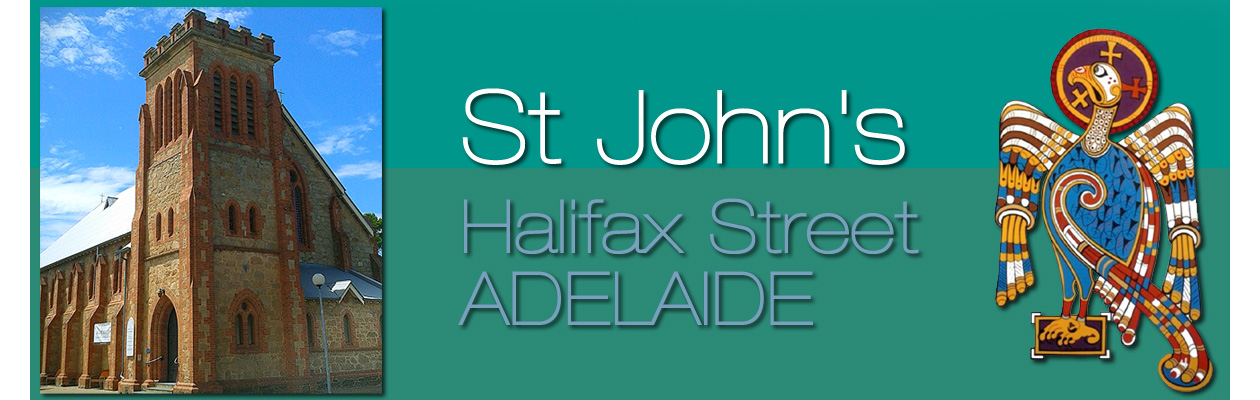
What might John ask of us who bear his name – St John’s?

John’s Hebrew name, יוֹחָנָן (Yochanan), means ‘God is gracious’ – ‘God gives undeserved gifts’. That’s a joy we discover daily in God’s beautiful creation. A community of Christ, hearts and hands overflowing with the riches of God’s grace. And like John, our call is to hand those gifts on – gifts which can pour through us from the never ending wellspring of God’s grace.

Let’s all read John’s Gospel and his letters again. We are a community of Christ as John was, in a very different world, yet ours is similarly often apathetic and hostile too. Like John, we have not seen and yet we believe. Because of John and our more recent forbears, we embody a culture as a Christian community of love, respect, compassion, generosity, humility, peace, vision, and joy. This culture springs from a living relationship with Jesus; the one who John reveals to be the eternal Word, our Way, our Truth and our Life.

I pray that together, we may believe deeper into Christ, and be living bearers of God’s Grace to all whom John has shown us Jesus loves so deeply. Amen.