
God calls us to love and care for each and every one

image_pdfimage_print

Rev’d Peter Balabanski

Pentecost + 6b – 2 Sam 1 – Ps 130 – 2 Cor 8 – Mark 5 21-43

Our readings today take us on a journey through lament, prayer and its effect, and our thanksgiving for that; and finally, they tell us that in the costly love of Jesus, we find the assurance that all these things are part of our faith for a good reason.

Lament: our first reading was David’s song of lament for Israel’s first king Saul and his son Jonathan—David’s beloved friend. If you read back through the story of that first royal experiment with Saul, it was a disastrous mistake. But the rebellious soldier David will now become the new king, and for all his faults, and the failings of most of his successors, he remains an inspiration to this day because of his childlike openness to the power of God’s love.

So out of the depths of despair and grief, God can raise new hope; hope like David’s life has inspired. And that’s what today’s Psalm tells us; something it’s been telling people for a very long time; trust in the Lord, for with the Lord there is mercy: and with him is ample redemption. Anyone’s lost-ness can be turned around – we can be found and brought back to safety.

Prayer and its effect – and that happens most astonishingly through prayer. I have a vivid image of the prayer of the Psalms that comes from my times in synagogues and particularly a time at the Western Wall in Jerusalem. Many hundreds of people were praying the Psalms of the day, often rocking and weeping as they did. And then a group of young people arrived singing and banging drums and tambourines as they danced their way to the wall. Both of them – the rocking, weeping people and the joyful young people were singing Psalms.

They could have been praying the Psalm we sang today, Ps 130; a Psalm written for when you’re grieving, and which points you to the certainty of hope and joy. It’s an old Psalm of ascents; a Psalm for people coming up to worship in Jerusalem. It’s an old poem, this Psalm. The people at the Western Wall weren’t praying with words they’d made up. The Psalms were made by poets like King David who first sang them more than 3,000 years ago. The Spirit of God gave them these words to sing, and they wrote them down so that we still have them to sing now.

We believe God has given us these Psalms to sing. And when we sing them, we belong to a huge community, thousands of years old, and nearly two-and-a-half thousand million in number today.

It means that when we sing this Psalm together, we know we’re sharing our worries with lots of people, and shared sadness and worry are easier to bear. It also means that with the rejoicing Psalms, we share them with all those people too, and shared joy gets bigger and bigger. And we’re also praying a prayer that we know God hears, because the Spirit of God inspired it in us in the first place. It’s been placed on our hearts. It’s good to learn Psalms by heart like those people at the Western Wall have. Because then, wherever you are, and whatever happens, you have wonderful prayers inside you, ready to pray. You’re never alone; your worries come into perspective, your joy grows; you know you are in the presence of God.

Thanksgiving – So we are grateful – obviously – but what then? Paul reminds the Corinthian church – and through them, us, that God’s gifts to us have come at a considerable cost. He reminds us that Christ, though he was rich, yet for [our] sakes he became poor, so that by his poverty [we] might become rich. And this is the model for us. As Christ-followers, we are called to hand on love and support even when that can involve considerable sacrifice. The redemption, the consolation, the community support that the Psalm enables for us – they’re not meant to stop with us. In Jesus, we find them a model to emulate. We are called to enable those whose souls cry from out of the depths to know that God has heard them. In praying, we open ourselves to being the means of that prayer being answered.

And it’s in the ministry of Jesus that we find all these things – lament heard, prayer heard, and thanksgiving expressed through generosity – all these are part of our faith. And today, we see it all expressed in the Gospel passage we’ve just shared. The exhausted Jesus we met on last week’s boat in the storm still hasn’t had any chance to rest and recover. Immediately upon his arrival over the other side, he had to deal with the Gerasene demoniac and his legion of unclean spirits. And upon his return today, the crowds are back, pinning him to the boat before he’s even had a chance to get out. And yet among all that need, and despite his exhaustion, Jesus finds it in him to redeem two lost people; a woman who had bled for twelve years, and a twelve-year-old girl who had died.

The wonder of this is that we can proclaim a God who is not only committed to justice and mercy and faith in a generalised, in-principle way, but a God who calls us to love and care for each and every one – and particularly for those left behind; those at the margins of everyone’s attention. Pray! You will be heard! … Amen.
Trust in God’s presence

image_pdfimage_print

Rev’d Peter Balabanski

Pentecost + 5b – Mark 4 35-41

In 1986, the hull of an ancient fishing boat was recovered from the western shore of Lake Galilee. Carbon dating shows it was from around Jesus’ time. The boat is about 8.1 metres long, 2.3 metres wide, and 1.4 metres high. It was flat bottomed and decked fore and aft, with room for around 15 people, four of them rowing when sails weren’t in use. It may have been in a boat like this that Jesus and the disciples crossed Lake Galilee – Jesus sleeping maybe on the stern deck, or sheltered under it. v. 38

Today we’re in a boat on Lake Galilee. We’ve set sail for the other side, and all looks fine. We’ve done this so often, it’s just routine; just like starting a new day at school or work. We set our course; we know what to expect; we’ll be fine. But suddenly we’re not; suddenly everything’s different; everything is terrifying. A fearful storm has suddenly blown up, and we feel frightened and cut off. No-one can hear our cries for help; we’re far from safety. How can God let this happen to us? Is God asleep somewhere; does God care?

For some of us, the storm might be different. Our storm may come as a sudden, frightening pain in the night; or when the doctor tells us our life can’t be the way we planned it any more. For some, our storm comes suddenly when the job we thought we had is no more. For some children and adults, the storm strikes us when someone we thought cared for us—someone we thought would stick by us—suddenly doesn’t any more, they hurt us or go away. Or maybe someone we imagined was going to live all our life suddenly dies.

But how can these things be called storms? What’s this storm got to do with our lives? This storm can be an analogy for the sorts of things can threaten my life or yours like this storm threatened Jesus and his friends. When storms strike us, we feel alone and vulnerable. We feel like God’s gone away, or gone to sleep. And we ask the question that Jesus disciples asked him as they woke him up. Don’t you care? We’re all going to die!

We’ve heard the story. He does wake up, and he tells the wind and the sea to calm down. Then he asks them why they’re afraid, and do they have any faith at all? But they don’t seem to hear this. They’re wondering about something else. “Who is this, that even the wind and the sea obey him?!” I think anybody would ask that question; and there’s really only one answer. Only God can tell the wind and the sea what to do.

But that’s not the whole story. Let’s just go back into the story a bit. Jesus, asleep in the boat, was so tired that even a great storm couldn’t wake him. He’d been looking after crowds of people for days. One day he didn’t even have time to eat. And yet, as he was teaching all those people, there were others telling anyone who’d listen that he was evil. And his family was nagging him to come back home and get real. He’d been fighting an up-hill battle. No wonder he was exhausted.

So we have in our boat the one who can command the wind and the sea; and we know only God can do that. But that same person in our boat is so exhausted, he escapes crowds and then sleeps through a storm that terrifies experienced sailors. And that’s a vulnerable human being. In our boat with us is the God who can command the weather and also in our boat with us is our teacher Jesus, who gets tired, just like anybody else. And they’re one and the same person!

For me that’s the unnoticed miracle in this story; God and you and I are all in the same boat. God is in our boat because that exhausted teacher is asleep in the boat with us; because Jesus chooses to be with us; to be one of us. We tend to think of the miracle of this story being that Jesus calms the storm. But maybe we could think of it as the miraculous story of how God shares our storms with us; how God is in the same boat with us. See this, and our life’s storms are very different things.

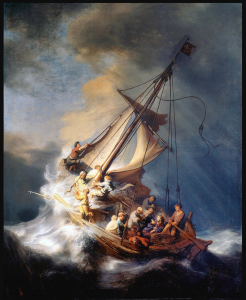
There’s a wonderful painting of this story by Rembrandt. I think he painted the exact moment of Jesus’ command to the wind and waves. Jesus is sitting in the back of the boat with a few of his disciples looking at him. It’s a still point in a wild scene. The water around the back of the boat seems calmer than it is everywhere else. The sail nearest to Jesus has relaxed a bit. But at the front of the boat, the storm is still blowing with full force; one sail is drum tight, the other is torn and standing straight out in the wind with a shredded rope whipping around above it. And the sailors there are hanging on for grim death; they look terrified.

What this painting says – what this story says – is this. Jesus came to be with us in the storms of our lives. Know that, and look for him. Jesus knows our storms. Tell him how your storms affect you; he’ll hear and understand. Sometimes God calms the storm, sometimes God lets the storm rage, and calms the child.

Let’s pray. In times of storm and in places of calm, God, we give thanks for being with us. In calls to go and in calls to stay put, God, we give you thanks for being with us. May we trust in your presence; trust your love because of Jesus. Amen.


The 54th anniversary of my priesting – Father John Beiers

image_pdfimage_print

Sermon for St. John’s Halifax Street on the 54th Anniversary of my Ordination to Priesthood

Last Tuesday was St. Barnabas’ Day the 11th of June, and I celebrated the 54th Anniversary of my ordination to the priesthood. Some of you have asked me whether I could speak in a sermon about where I been, and what had happened in my ministry, because you knew very little about me and my origins. So here goes, with a few remarks also about St. Barnabas.

My Early Life

I was born in 1937 in QLD, in an obscure village of about 12 houses called Mungar

Junction, near Maryborough. I had a very loving family, (mother, father and two brothers), and I had an idyllic childhood, roaming free on my bicycle on the bush roads. Every month we made the trip into Maryborough to go ‘to church, and it was at the age of about 8 that I felt a calling to the priesthood.

Next came High School, and then University, when we moved to Brisbane. I gained a bachelor’s degree in mining engineering, and did 5 years post-graduate work, before going to Broken Hill to work underground to obtain my Mine Manager’s Certificate. After that I went to St Francis’ College in Brisbane to study for the priesthood. There, on a College Mission to Charters Towers in NQ, I learned my first lesson — that all visiting, and mission work needs to be placed in God’s hands before you start. Though there may appear to be little result, God has used you to place one more piece or pieces of the jigsaw of faith in someone’s life.

As I move from one part of my ministry to the next, I want to share with you some of the things that God taught me at each step.

I was ordained a priest on the 11t of June, 1970, Ste Barnabas’ Day. Barnabas’ actual name was Joseph, and he came from Cyprus, and there is quite a lot about him in the Acts of the Apostles. However, the apostles nicknamed him “Barnabas” meaning Son of Consolation, or the one who encourages, because of his kind and encouraging manner, his understanding heart, and willingness to take a back seat when someone greater than he came on the scene. As St Luke puts it, he was “good man, full of the Holy Spirit”, You cannot give a person a greater compliment than that! I tried to model my ministry on his, react like he might have, and learn by experience. He was martyred at Salamis in AD 61.

Bundaberg

I was sent to Bundaberg in 1970, where the rector was supposed to have a problem with alcohol. But he had had a stroke earlier in his life, which left one side of his face drooping, as if drunk. So, rumours abounded but he was kind, holy, and prayerful, so I learned not to listen to rumours, or judge from outward appearances.

Once a woman in the parish mis-heard the words of a sermon I preached and refused all attempts of mine to set matters straight. It was crucial that this happen by the next Saturday night, The rector Wd me to pray and believe, On Saturday afternoon I met her and it was as if nothing had ever happened. Thus, I was taught the importance of persistent, believing prayer. I also learned how to handle 5 Masses on a Sunday in a big parish.

St George

I was sent to St. George (Q) in 1972, a grazing and cotton growing centre. Here I learned how to accept with gratitude the gifts of grateful parishioners, and not feel that I had to respond in kind. I was taught that there is a God-like innate compassion in folk who never come to church. My brother, aged 21, was killed in a car accident near Seymour, Victoria, and that weekday afternoon, the church was filled with people for Evensong. A man I did not know told me to be ready at 4.00am the next day, and he would drive me to Newcastle so that I could take the funeral without stress.

It was here that I came to understand the charismatic renewal, and was introduced to the church’s ministry of healing, through seeing a woman healed of a brain tumour before my very eyes, in two days.

It was here that, after a disastrous flood which left dead sheep hung on barbed wire fences for miles and miles, that I feared for the faith of a young grazier, who had lost 9,000 sheep. He looked at me and said, “God has left me 1 ,000 sheep to start over again with.” It was here that I was called to a stockman (whom I did not know) in Dirranbandi hospital, 80km away, on a wet and windy night, who wanted to see me before he died of cancer but was hanging on to life. I did not want to go, as the black soil roads were slippery like ice, and I had a very small car and no-one in their right mind would travel that night. But I went, unwillingly, got bogged, sat glumly in the car, and was pulled out by the only car to pass me that night. At the hospital door I took off my mud-caked boots and gave the emaciated man the last rites. As I blessed him, he folded his hands on his chest, and just stopped breathing. I went outside on to the verandah and cried, asking God for forgiveness. I learned then that no matter who we may be, God can still use an unwilling servant. This was to be the greatest lesson I was ever to be taught.

Cunnamulla 

In 1975, as Head Brother of the Bush Brothers of St. Paul, I moved to Cunnamulla, where there were three brothers in the one house. There was a problem with the isolation of the rest of the Brothers whom I was expected to visit regularly. We prayed about it, and it seemed good to us and the HS that we should buy a plane do the job. So, in faith, I learned to fly, and we bought a Cessna 182. We did not actually have the money for the plane, but that year, our income increased through bequests by $20,000, which was the exact price of the plane.

Here I realized that Ecumenism began in the Outback, Because of the lack of young men and women, marriages tend to take place between young people from local cattle stations. Thus, Anglicans and Roman Catholics tend to intermarry, so that there are many blended families. In times of crisis, your neighbours are the only people that stand between life and death, so denominational difference is not an issue in the Outback.

It was also my job to take the Brother at Quilpie to minister to the station people from Quilpie to Birdsville, and to the north and the south. Arrangements were made weeks in advance through the Flying Doctor Radio Network based at the Birdsville Hospital. We would visit three stations a day for 5 days. One for morning smoko, one for afternoon smoko, and one for a Community Mass and a bed for the night. This was not difficult, as the stations were often only about 150 km apart.

Charleville

In 1978 1 moved to Charleville, where I had an episode with peritonitis, and moved to Dubbo as my new base. The Brotherhoods wound up in 1981, and I was asked by Archbishop Rayner to go to a Port Adelaide and make peace between the Catholics and Charismatics. That was not difficult, as both groups believe strongly in sacraments, prayer, love and healing.

Port Adelaide

This was, at last, a settled ministry, with only three churches. It was here that I was taught the importance of not moving until there was unanimous agreement in the parish council. No one wins, no one loses.

It was here that I learned the joy of being part of every family, and the ministry of healing expanded to include exorcism of houses, of which there were many. It seemed as if I could spend the rest of my life here. But in 1988 I was asked to go to Normanton, on the Gulf of Carpentaria, as p.i.c. of a parish with 7 far-flung centres of worship, each 150 km distant from the next. One unfair attraction was that I would be the assistant pilot of the Diocesan plane. I was confused, so I asked the 6 of the most prayerful parishioners to pray about this and ask God what HE wanted. All but one reported back that I was to go to Carpentaria. The last one said he was unhappy with my request to pray about it.

Normanton

So in 1988 I went to Normanton. It was extraordinary. It was part of my job to fly round all the parishes from Normanton to Cairns, and all points north to pick up people from the parishes for Diocesan Council, Clergy Conferences, Retreats and Synods and fly them to Horn Island, the airport for Thursday Island. I had also to fly round all the islands in the Torres Strait collecting reps for these functions on Thursday Island. In my first year, I was also locum at Cooktown, which I visited by plane once a month.

So, I would spend on an average one week in Normanton parish, and the next week piloting the plane, a Cessna 210, a 6seater. I obtained my First Class Instrument Rating at the age of 51 , and so could fly in all weathers whenever required, in relative safety. My most joyful moments, however, were when, after battling  rainstorms for two hours down the QLD coast, in zero visibility, at night, I descended through the clouds to 300 feet, and could see the high intensity runway lights of Cairns spread out before me, welcoming me to land. Thanks be to God!

Aberfoyle Park and Clarendon

Finally, in 1992, I left for AB and Clarendon. That was a wonderful parish in a different way. It was new, having been started by Fr. Gene Bennett, and it had no traditions. All the parishioners were new, or converts from other denominations, so their outlook was fresh and willing to try new things. I had a ball! I retired in the year 2000, and it was then that I developed high blood pressure. Amazing! Since then I have done many locums, both in the Diocese of The Murray and Adelaide, and finally made my home with God’s people St. John’s. I still maintain a quiet ministry based at my retirement cottage for those seeking prayer, consolation and healing.

Thank you for celebrating with me my 54th anniversary of priesting. I have had a privileged life, and I thank God for all that He has taught me.


Be a support for those with mental illness

image_pdfimage_print

Reverend Dr. Elizabeth McWhae

1 Samuel 8:4-11, 16-20, 14-15,  Psalm 138,   2 Corinthians 4:13-:5:1, Mark 3:20-35

INTRODUCTION

When Peter asked me to speak about my chaplaincy work I wondered what could I say about mental health chaplaincy that people would find interesting. So I went and checked the readings for this Sunday and the Gospel from Mark had the answer. In particular this verse referring to Jesus as those around him said “He has gone out of his mind”.

What more do I need, than this verse as a starting point, to talk about mental illness.

POINT 1

Having worked as a Mental Health Chaplain for 26 years, in both public and private psychiatric hospitals, I can tell you that it’s not just patients who have gone out of their minds, but staff as well, as they try to navigate the complex and often confusing world of mental illness.

So this morning I thought I would talk about what we mean when we say someone is out of their mind or out of their right mind, or to use a more politically correct term, mentally unwell. The first thing I want to say, very strongly, is this, anyone can develop a mental illness. Mental illness can happen to anyone, simply because we all have brains that can stop working well. So, it doesn’t matter how intelligent or slow we are, how strong or weak we are, how well off or poor we are, in what country we live, if we are city or rural dwellers, if we are single, married, de facto, gay, straight, widowed, or orphaned. No one is immune to mental illness, although some people may be more prone to it, but just like Covid or the flu, we can all get sick. Some people with a mental illness have insight or recognition about their unwellness. Other people appear to be completely insightless, deny that they are unwell, refuse treatment completely or are non-compliant.

And I think many of us know where that can lead.

POINT 2

So let’s ask the question, why does someone become mentally unwell? As you may guess, there is not a simple answer to this but many factors worth considering. Firstly there are biological factors such as genetic predisposition to certain mental illnesses, like bipolar disorder, schizophrenia and depression. There are also situational factors such as upbringing, various forms of abuse, grief and loss, living in a warzone comes to mind as well. Often a person has both biological and situational factors that contribute to their illness. Sometimes a person may have other illnesses that contribute to their mental illness, such as chronic pain from arthritis, a neurological disease or cancer. Then there are substances that if abused may lead to mental illness, for example alcohol, illicit and over prescribed drugs. And of course there is the age factor. As people age and develop more illnesses, these may contribute to mental illness as well. For example, it is not uncommon for someone with dementia to develop paranoid ideas.

So what I am saying is that many factors contribute to a person’s mental wellbeing or illness. It is possible to have a period of being mentally unwell and then things return to normal again. It is also possible to have recurring times of wellness and sickness. It’s possible to live one’s whole life without any mental illness. It’s equally possible to develop a mental illness in one’s youth and never to be well again.

POINT 3

As a community of faith, what does all this have to do with us? Quite a lot really. As a community we are called to love, accept and care for those who are sick and vulnerable. Jesus was always interested in those who were outcasts in his day. Today’s outcasts are often the mentally ill. Ask anyone with a serious mental illness and they will tell you about abandonment, from family, friends and society. Jesus always had time for outcasts. So should we. In fact Jesus spent a good portion of his time being an outcast from his family, from the synagogue, from some of his disciples. He even felt an outcast from God. “My God, my God, why have you forsaken me?” was his cry from the cross.

I have often thought that a good indication of how welcoming a Christian community is determined by how welcoming they are of anyone who may be mentally struggling. And I always assume that any one of us could be that person. So we should be open and prepared for people to discuss their mental health or illness, if they wish to, and at the very least know that this is not a taboo subject.

CONCLUSION

Our world is a difficult place to inhabit at this point in time. It is not surprising that many people struggle with their mental health. I find it very interesting that while we as a society seem to acknowledge the growing number of people struggling with their mental wellbeing, at the same time we have far less hospital psychiatric beds now than 20 years ago. As a Christian community let us make every effort to address this issue with wisdom and sensitivity. Let us avoid simplistic answers to very complex problems, but rather listen, learn, share and offer support. Amen.


Servant Leadership

image_pdfimage_print

Provided by Rev’d Peter Balabanski

Pentecost + 3B –1 Sam 8, Ps 138, 2 Cor 4, Mk 3 20-35

The subject of today’s Bible readings is servant leadership. Three of today’s readings are about how we receive God’s leadership—we who proclaim God as our guide. They’re about the way we receive God’s leadership, and also about the type of people who should, in God’s view, be leaders among us.

The Psalmist knows God’s in charge. 2I will bow down toward your holy temple and give thanks to your name because of your faithfulness and your loving-kindness, for you have made your name and your word supreme over all things. Kings praise God. But there’s a verse we might miss if we’re not awake, 6though the Lord is exalted, he looks upon the lowly and he comprehends the proud from afar. God’s interested in the little people. God won’t mix with the proud. So leadership among God’s people is not to be given to those who would seize it. Such people are not close to God. True leaders in God’s community are more likely to be called from among the lowly—the meek—and leadership in God’s community is to be focussed more on the needs of the lowly than on the rich and influential.

The reading from Samuel underlines this. Leadership in God’s community is not like leadership in the secular world. Israel already had a wonderful leader in Samuel. Samuel had been close to God all his life. So as Israel’s judge and prophet, he gave wise and faithful leadership. In Samuel’s time, God was tangibly there with the people of Israel, as provider and protector. But the elders knew Samuel’s sons were nothing like him. They panicked. They couldn’t see an obvious succession plan. So they ganged up on Samuel; tried to bully him into giving them a King; the sort of leader everyone else had. Samuel was naturally upset, but his first response was to seek God’s wisdom; he prayed.

And obeying God, he warned the elders about the sort of leadership they could expect from a king. He was right, of course. What he said remains true to this day—except that the 10% taxation he predicted was not where it would stop.

But the question for us remains: the leadership of God’s people, what’s it about? True leaders I’ve known are always thankful people. They see the best in everyone, and they have a strong sense of their servanthood. They want to offer something back; particularly to make a contribution to people who struggle—to raise them up. And we know from the footwashing story in John’s gospel that this was the spirit of leadership that Jesus has called all of us to exercise.

Today’s Gospel specifically warns us about bad leaders. Jesus’ family and the crowds, knowing the leaders they have, begin to be afraid for Jesus’ safety. His mission’s become too high-profile. He must be mad to let this happen. Vested interests both in the temple and in the political world are very dangerous. Question the authority of these people and they bite. We know the story of Jesus’ arrest and execution; they bite very hard.

But the family gets to him too late. The authorities are already down from Jerusalem and they’re taking matters in hand. Their tactic is slander: they publicly declare Jesus to be in league with the devil. Slander is utterly forbidden among God’s people: the ninth commandment says—You shall not bear false witness against your neighbour. The religious leaders from Jerusalem misrepresent Jesus’ care for the needy with their malicious, lying slander—he has a demon. That’s bad leadership.

We know that slander still remains a tactic that leaders use against the people who threaten their power. The tragedy is, it poisons the spirit of any group or society which accepts leadership from them. We find out why after the next few verses.

Jesus begins to respond to their slander with the parables of the house divided and robbers binding the strong man. His parables expose the falseness of their slander. But his next words are terrifying. 28 ‘Truly I tell you, people will be forgiven for their sins and whatever blasphemies they utter; 29but whoever blasphemes against the Holy Spirit can never have forgiveness, but is guilty of an eternal sin’— 30for [the scribes] had said, ‘He has an unclean spirit.’

The scribes saw Jesus heal people and exorcise demons from them by the power of the Holy Spirit, but they called this Holy Spirit power satanic. Jesus says what they have done is an eternal sin—the unforgiveable sin. I remember being terrified of this as a teenager. I thought I might have done it. But actually, committing the unforgiveable sin is pretty hard. It means seeing a wonderful act of the Holy Spirit, and fully in your right mind, calling it evil—calling it a work of the devil. Few people will sink so far.

But when a leader is known to resort to malicious, lying slander—to call good works evil—and when the people they lead know this, yet still accept their leadership, it can poison the spirit of that group or society. They are being led astray in a most Godless manner, and they are knowingly following this lead. Someone must warn them: name the evil and warn them. And that’s where we come in. We—Jesus’ family—brothers and sisters and mothers of Jesus.

Jesus identifies his true family as those who do the will of God, like him. That makes us leaders like him—servant leaders. And the calling of servant leaders—from what we’ve read in the Scriptures this morning—the calling of servant leaders is to heal the sick, and to deliver the weakest and most vulnerable from whatever oppresses them, and to do this work without fear or favour.

Deliver the weakest and most vulnerable from whatever oppresses them. We know who they are—they are people slandered by false leaders:

  • Aboriginal people whom our society fails;
  • victims of abuse and attack who cry out for justice, yet are slandered by those who say they were asking for it because of how they dressed;
  • refugees;
  • the unemployed;
  • the homeless;
  • the mentally ill;
  • victims of disaster;

all of them so often falsely accused, and, so, just like Jesus. As he said, … “Truly I tell you, just as you [cared for / stood up for] one of the least of these … you did it to me.” Mt 25.40

So how do we serve Jesus? By doing as he did; by serving those he served—and in our service, we offer the world the type of leadership which alone heals and makes it whole. This is our calling as the royal priesthood of all the baptised. Amen

Treasure in Clay Jars

image_pdfimage_print

Rt Rev’d Dr V. Devasahayam – former Bishop of Madras, Church of South India

II Corinthians 4: 5 – 12

  1. Container: Pot of Clay

Treasure boxes are ornate to reflect the worth of what is inside.  They are very durable to preserve the riches within.

Clay jars: unimportant, insignificant and inadequate, not valuable, made of common material, cheapest storage container used to store trash or refuse, expendable, easily discarded and replaced if broken.

Jar of clay: Human beings, lives of Paul and his team – Jesus’ choice of disciples – This is to show that the surpassing power belongs to God and not to humans.

“For if anyone thinks he is something, when he is nothing, he deceives himself.” (Gal. 6: 3)

  1. Content: Inestimable Treasure

‘Vessels’ are made to contain something, the sole purpose of the container. The vessel is not much in itself, but by what it holds, an inestimable treasure.

If the substance is not there, it is an empty vessel experiencing ‘neurosis of emptiness’, leading to loss of goal, meaning, purpose, life goes dead, leading to restlessness and rebellion.

Content or treasure is of a pearl of great price that a person would be willing to sell everything he had in order to obtain it. (Mt. 13:44): Jesus, the Gospel, Salvation – without this treasure, human life is empty.

The focus would be on the beauty of the treasure and not on the container.  We are to draw attention to Jesus, not to ourselves.  We have to glorify God and not get credit to ourselves: ‘we proclaim Jesus as Lord and ourselves as slaves’; Baptist: “He must increase and I must decrease.”

We are called to preserve the treasure: our relationship to Jesus becomes precious and of priority.

We are called to pass it on to others, that others might have this treasure of their own.  We have to tell others about the glorious things that we saw and experienced.

  1. Conserving Power: Transcendent Power

It speaks of the persecution genuine believers face when they tell people about Jesus, facing the same type of attacks that Jesus did, which resulted in His death (John 15: 28-20; Luke 9:23). Speaking the truth and standing on God’s word may be costly.

Peter: ‘Do not be surprised at the fiery trial…. But rejoice and be glad …. For suffering results in glory. (I Peter 4:12-14)

The secret of experiencing the life of Jesus is an attitude which welcomes the cross and gladly consents to having the ego crucified within us, as in the story of Gideon (Jud. 7:20-22). The vessel must be broken in order that the torches in the pots may shine forth. Our lives are hidden so that Christ is on display.

“We are afflicted in every way, but not crushed; perplexed, but not driven to despair; persecuted, but not forsaken; struck down, but not destroyed.”  There is a power within, a transcendent power, which keeps pushing back with equal pressure against whatever comes from without.” A person who depends on his own strength would be shattered by these things as an earthen pot. God gives supernatural and sustaining strength.  God gives strength to get through and still reach people for Christ.

Suffering always reveals the weakness of the humans and greatness of God. God’s power is on its greatest display when it transforms a weak, selfish, fragile, broken human as a strong believer in Christ.

‘Death is at work in us but life in you’: In facing physical death and persecution, they brought spiritual and eternal life. Jesus: ‘the grain of wheat bears much fruit when it dies.’

Celebration of the Lord’s Table: It is the death of Jesus, producing the life of Jesus to be manifest within us, in order to be shared with others.