
God the Most Holy Trinity – three persons yet one God

image_pdfimage_print

Rev’d Peter Balabanski

Trinity Sunday 30-5-2021 Isa 6 1-8 Ps 29 Rom 8 12-17 Jn 3 1-17

Sisters and brothers…you didn’t receive a spirit of slavery…you’ve received a spirit of adoption. 16… that very Spirit [bears] witness with our spirit that we are children of God…joint heirs with Christ.

Paul packs a lot into a tight space, doesn’t he! Let’s unpack it slowly, and see what Paul might want to tell us on this Trinity Sunday.

There seem to me to be two layers of meaning. Firstly, there’s us on the receiving end of God’s kindness, and the implications that has for our human relationships. Then there’s God’s outreach to us which we experience as three co-operating forces acting in perfect harmony: encouragement, adoption, and incorporation into the family of the Father, Son and Holy Spirit.

So to the first layer of meaning: the human level. Paul calls the people he’s writing to sisters and brothers. (We can safely assume he means us too.) He says their and our status in the household of faith is not that of slaves but, as the Spirit bears witness to our spirits, we are God’s children.

Just as he experiences his membership of the body of Christ, Paul is saying that the Roman Christians (and we) are free, full members of God’s household; children – siblings – in our own home. So he says we have the astonishing privilege of being joint heirs with Christ. This is about close relationship; not insiders and outsiders – no lower or upper caste; no hierarchy, but shared, intimate, equal family life.

From his own personal experience as a former persecutor of Christians, Paul knows just how astounding it is that we Christians may be described this way: as siblings, as God’s children, and as joint heirs with Christ – no matter what our background. And that adds to the wonder of what he’s saying because the Roman church was profoundly split along ethnic and social lines.

The other layer of meaning in this passage is found in the three ways God offers us this privilege of belonging in the family.

Firstly, the words ‘we are children of God’ mean God has chosen to relate to us as our parent. Our tradition has responded; we call God our Father – or our Parent – Source of our Being. Before, we related to God more as our maker and our judge. But being invited to call him Father says this Maker is more than an artisan at work; and this judge is on our side. All this transforms our relationship, both with God and with each other, to family. This is the will of the Source of our Being.

Secondly, we are named as joint heirs with Christ. Jesus is the true heir of the Father! This teaching acknowledges Christ as equal with the Father. Just as any human child shares the human nature of their parents, Christ shares fully the divine nature of the Father. And he has taught us to pray and call God our Father too. How astonishing is this privilege for us?! And there’s that family connection again – with God and with each other – through Christ. He called us by his life and ministry, his death and resurrection and ascension into this relationship.

And thirdly, the Spirit bears witness with our spirits that we are children of God … joint heirs with Christ. Again, I have to say this is an astounding honour. And there it is again too – the connection is a family relationship – which Paul affirms by calling us siblings, both to himself and to each other. It’s a family relationship which he has now told us has the threefold stamp of encouragement adoption and incorporation into the family of the Father, Son and Holy Spirit.

This has a special poignancy when we remember that Paul was writing to a divided church in Rome. As I’ve said, the Christians there were divided along ethnic and social lines, like many modern churches are. But he called them all siblings – siblings to him, to Christ, and by logical extension, siblings to each other. And he did so by asserting that this relationship was one deliberately established by God the Holy Trinity, as we’ve just seen.

Who would have imagined that the doctrine of the Holy Trinity had anything in it about breaking down ethnic and social barriers? Who would have thought that the doctrine of the Holy Trinity meant anything about our identity – about our relationships with each other – about us? But it does. Whatever our race or social standing, we’re siblings. Paul most famously spelt this out in his letter to the Galatian church 3.28 28There is no longer Jew or Greek, there is no longer slave or free, there is no longer male and female; for all of you are one in Christ Jesus.

That rather knocks the stuffing out of racial and social prejudices, doesn’t it. Racists and snobs and misogynists are right out of touch with this ultimate reality about the way God sees us all. And it goes right back. In Genesis 1.26, we read: 26aGod said: Let us make human beings in our image, after our likeness.

Today, with our focus on God the Most Holy Trinity – three persons, yet one God – God in community, Paul teaches us that being in God’s image, after God’s likeness means being community, and so rejects forces of disunity. And it doesn’t mean a choice for slavish uniformity; it means seeking harmony in diversity.

Perhaps our musicians can demonstrate that with the notes E,G and C. Until we hear the three notes together, we don’t know what key signature we’re dealing with. Without knowing God as Trinity, we’re missing out on who God is, and who we are called to be.

Paul has just given us a lesson about God in community calling diversity into harmony. God whom we worship, God in whose image and likeness we are made – God is a community. And we discover our true selves as the image and likeness of God – in our family connection with God and with each other – in a choice to be community; family to each other.

And here we are; a community of people who are mostly not related to each other, and who probably wouldn’t know each other if it weren’t that God has adopted us all into this family. And somehow, together, we are the image and likeness of God. Our pilgrimage – our journey of faith – is to discover that, and to live it – discover who we are, why we’ve been called, and importantly, to ask What now?

Paul gives us a picture of the community of love that is God at work. We see it most clearly as an example to us in the ministry of Jesus – who is himself God. Reaching out to ex-communicated people, Jesus gathers these to himself. He incorporates them into a new family, if necessary, staring down ex-communication himself from a society which sets itself apart and keeps all the belonging to itself.

The community of love that Jesus models – and that is our calling too – is outgoing – active – notices these ex-communicated ones and includes them.

Such is our lesson this Trinity Sunday. Amen
Opening the Kingdom of God to everyone

image_pdfimage_print

Rev’d Peter Balabanski

Pentecost  Year B – Ezek 37 Ps 104 Acts 2 John 15-16

Spirit and New Creation When you take away our breath, we die. When you send forth your Spirit, we are created, and you renew the face of the Earth. Ps 104.32 APBA

Today, as at every Whitsunday, we’re presented with a vision of the first Pentecost – new Spirit-life being poured out into our existing life; new life poured out to renew us and make this life even more abundant, more inclusive, more diverse.

Acts 2, tells us how crowds of Jews from all over the world had gathered in Jerusalem to celebrate Shavuot – the Jewish feast we Christians call Pentecost. In the Jewish faith, Shavuot is the Spring festival, celebrating God’s gifts of the Law and the wheat harvest. It’s a celebration of God’s on-going provision to those who live in the secure haven of God’s Law. (Deut 7:12-13) It celebrates the ever-new gift of abundant life. So the crowds gathered in Jerusalem were already there to celebrate God’s abundant providence, but suddenly, even more life was poured out on them.

The immediate miracles of this story are the disciples’ sudden burst of courage and the diversity of languages. Newly leaderless fishers and farmers from the backwater of Galilee suddenly burst into the crowd proclaiming God’s deeds of power. And they do so in all the tongues of the known world, all at the same time. The crowds of faithful Jewish people had gathered from all the home-countries of those languages. That day, they were all invited to take new hold of their birthright; to embody the commissioning of Abraham and join God’s mission to bless all families of the Earth.

Before the Holy Land and its people ever existed, God had promised Abraham that in him all the families of the earth would be blessed – that Abraham and Sarah’s descendants would become the people through whom God would bless all families of the Earth with abundant, ever-new life.

Isaiah spelled out this destiny of Israel in an oracle from God: 42: 6 I am the Lord, I have called you in righteousness, I have taken you by the hand and kept you; I have given you as a covenant to the people, a light to the nations … and today, here it was all happening in their sight and hearing.

The crowds listening to this multi-language sermon – the mighty deeds of God proclaimed in all their languages at the same time – all these people were being commissioned. They should each carry this gift home with them to every country they’d come from. The Jews’ time for being set apart was over. From this moment on, the Good News of God was officially launched to all families of the Earth.

The blessing is handed over, and it’s marked with fire, just as it was many centuries earlier with the burning bush Ex 3 and the pillar of fire. Ex 13 Our Paschal candle has proclaimed this for the through the Easter season. And with this blessing of holy fire came a gift of prophecy, another sign of the Spirit’s presence. Num 11.24ff Fire marked out each disciple as Spirit-filled, and the prophetic words they spoke in the tongues of every nation staked out God’s claim on the whole Earth.

That Pentecost, that Shavuot, that day, it sounds as if God cranked the amplifier and converted a solemn religious ceremony into a birthday party. The followers of Jesus became something like living, speaking birthday candles – like the burning bush, ablaze, but not consumed – speaking the very words of God to a crowd who’d never dreamt they’d hear such words spoken directly to them.

Birthday party? My dear old mentor, Brother Gilbert, used to scoff at preachers who called Pentecost the birthday of the Church. ‘Rubbish!’ he’d roar. ‘The birthday of our faith is the call of Abraham’.

He was right, of course. He always was. But I might just defy him for a moment longer. If I dared to call Pentecost a birthday, I’d have to say that Pentecost is like our twenty-first birthday – our coming of age. We were given a key that day – a key to open the Kingdom of God, but to others – to everyone.

And it’s vital that we do. All families of the Earth do know life, but do we all know it in the abundance God wants for us? What’s the Psalmist telling us? ‘God sends forth the Spirit…and the face of the Earth is renewed” 104.32 We join today with the whole Earth calling on the Spirit to come and renew the face of the Earth!  Amen.

The Ascension of our Lord

image_pdfimage_print

Rev’d Peter Balabanski

Year B – Easter 7 – Acts 1 1-11 Ps 93 Eph 1 15-23 Mk 16 15-20

The Ascension of our Lord is one of the five great festivals in the Christian calendar. Yet it often goes almost unnoticed. It falls on a Thursday, so there’s a tendency in some traditions simply to overlook it; a sort of poor cousin, left high and dry between our celebrations of Easter and Pentecost.

In traditions which do focus on the Ascension, you’ll often see it represented in art that’s based on this morning’s reading from the book of Acts. It often shows sad-looking disciples looking up at a cloud that has a pair of feet protruding from its base. Maybe that cloud is meant to represent the one in Exodus which shrouded God by day, leading the people from Egypt. If so, it’s a powerful connection; it then makes the Ascension pictures about God leading us from slavery to freedom. But for many people, the seeming farewell focus of Ascension art seems to emphasise losing Jesus; like our extinguishing the Easter candle just now seems to as well.

That’s where I find the painting (on our service booklet) by the late Indonesian choreographer and painter Bagong Kussudiardja to be so powerful as an exposition of Christ’s Ascension. He shows with explosive energy the incarnation of God in human form taking that human form into the divine. And, according to the image our epistle and Gospel readings give us, that human form now sits at God’s right hand. So we have a human voice representing us at the throne of grace. And that also means in some mysterious way that we have divinity represented in every child of God on Earth too. We have a voice interceding for us at the throne of grace.

At this point in our nation’s history, this image, where one of us speaks on our behalf in the throne-room, is echoed for me in the Uluru Statement from the Heart; the declaration that the original custodians of this continent presented to our government in 2017. It called for an Aboriginal voice enshrined in the constitution; a voice that would speak for first peoples to our parliament.

No wonder it felt so prophetic; it was calling on our government to follow in God’s footsteps and, like Christ’s Ascension, give an oppressed, alienated people a voice in the throne-room.

The connection I see between the Statement from the Heart and the Ascension is this; Christ’s Ascension to the throne of grace where he intercedes for us signifies the arrival of the Kingdom of God for us in the form of full citizenship with all its rights and privileges. Finally, full representation, full citizenship in the here and now. And that’s what the Statement from the Heart proposes for the first-nations people of this continent – finally, full citizenship in the here and now.

I find this practical, here-and-now link with the Ascension is one which helps to broaden my understanding of our faith. And that’s a good reason for insisting on marking the feast of the Ascension today. If we’d just left it to pass silently by apart from a handful of us on Thursday – the poor cousin to Easter and Pentecost – we’d miss the perspective it gives us on the wider plan of Christ our King.

Easter speaks to us of resurrection, reconciliation, new life, and triumph over sin and death. And Pentecost speaks of our participation in the power and life of the Spirit. And they’re all central to our faith. But with these, our focus can be unwisely confined simply to the effect on us – us at the centre of everything.

Ascension widens our focus to direct our eyes to Christ and see in him our risen, ascended, glorified King. And Ascension opens our eyes to the nature of the Kingdom – to what Jesus called the weightier matters of justice, mercy and faith. Mt 23.23 Certainly, Easter and Pentecost are front and centre, but without the wider, Kingdom perspective which Ascension gives, our understanding of them is diminished.

This Kingdom perspective helps us live in the paradox of Jesus’ absence and Jesus’ presence, God’s absence and God’s presence. Jesus is no longer among us, and yet we affirm that he is with us. We can’t touch him or see him, yet we meet him physically and spiritually in each other, and in the experience of the broken bread and wine poured out. Everyday yet extraordinary – God is totally beyond us, and yet through the Ascension, more intimately connected with us than ever. That is a wider perspective, and so somehow more freeing and inviting – calling us beyond our perspectives. For me this is summed up amazingly in the prayer of the week from APBA p. 519.

O God,
you withdraw from our sight
that you may be known by our love:
help us to enter the cloud where you are hidden,
and to surrender all our certainty
to the darkness of faith
in Jesus Christ. Amen.

Let’s rejoice in the Ascension. And at Pentecost, filled with the Spirit, may we feel the warmth of God’s presence, comforting and strengthening us as we live in the paradox of separation from God, us with God, and God with us. Amen.

You didn’t choose me but I chose you

image_pdfimage_print

Rev’d Peter Balabanski

Easter 6 b  – Jn 15 9-17 Acts 10 44-48

Jesus said, You didn’t choose me but I chose you. Jn 15.16 It’s easy to lose sight of that – I/you didn’t choose him; he chose me/you. It’s quite confronting. I understand it to mean that Jesus acted to take hold of you and me before we even knew about him. It’s disconcerting enough to have our children flexing their independence and doing things without permission; it’s positively unnerving to have our God doing it too! Say goodbye to a comfortable, domesticated God!

This means that our faith is about choosing to respond to God – getting on board with initiatives that God calls us to; accepting the outstretched hand of God. It also means that if we walk out on the Church, it won’t make Jesus give up on you or me. Remember, he chose us! What we might do for Jesus won’t cause him to respond to us in love; he loves us anyway. Whatever we do, to please him or to cross him, his love for us is there. It never wavers. It’s just there; and that’s the force which can nourish and grow you and me into a people who are a blessing for the world.

Today’s reading from the book of Acts shows the earliest Church discovering that Jesus chooses people they never expected. They’re amazed; people who aren’t Jewish are given the Holy Spirit. You didn’t choose me; I chose you. We don’t often think about Jesus calling the shots; even less that he does it in such dramatic ways. We’re not used to dreams and visions and angels being part of our decision-making processes. We tend to make fun of that – to say it’s how fundamentalists think. We tend not to trust people who claim a special relationship with God.

Such misgivings can colour how we read scripture. If you take some today’s Gospel verses (10,14 & 16) out of context and read them literally, you might see a protection racket; Jesus saying something like ‘10 Do what I say, and you’ll be okay; 14 I’ll like you if you play by my rules; 16 Hang around with me, and I’ll see you do well out of it.’ Looks pretty worrying, doesn’t it. Someone who knew nothing else about Jesus, flipping open the Bible at this page, would probably balk at it. But they needn’t.

How would you help someone understand this Gospel passage? How would you open it up as good news for them? We’ve each been charged with doing just that. Personally, I usually start by looking at context. It always explains a lot.

The immediate context of this passage is the verses we read last week – I am the true vine. We’re reading through Jesus’ farewell to his disciples before he’s crucified. He’s giving them a message of a choice for love and friendship. When he talks of commandments, his command is to love like he does. And his master-servant relationship with his disciples, it’s laid aside, as he offers us his friendship.

He’s telling us about building a community of love, where the only measure of a relationship is the law of love. Keeping that law builds community that’s safe for all who belong to it, and any newcomer. We think only Jesus can create something so wonderful, yet today we hear him asking us to embody his creativity and trustworthiness. So when Jesus talks about us asking something in his name, v.16 c he trusts that we’ll ask what he’d ask – that we’ll be loving like he’s loving.

This looks back to last week when we heard Jesus tell us he’s the vine and we’re the branches. As his branches, it’s natural that we’ll genuinely express his care – particularly for the frail, the frightened and the needy. He’s chosen them. And we are his representatives, called to express his care for them.

As Christ’s branches, we are to reach out and provide hope and shelter and sweet refreshment in their season. Just as he reached out to us and grafted us onto him, we are to offer this belonging to others too – to offer without condition a connection, through Christ the vine – offer them connection with the true source their being, with a true reason for being. But like any branch, we can only draw the strength to do all of that from the vine; Jesus, the true vine.

That’s quite a bit of context, but it all helps to build bridges of unbreakable, free belonging. It helps us and all who hear this Gospel to know that his call to us, his way of love, his kindness and understanding can bring to a broken world the healing and peace of faith, hope and love – new life; true life.  Amen

I am the vine and you are the branches

image_pdfimage_print

Rev’d Peter Balabanski

Easter 5b  I am the true vine – John 15 1-8

In John’s Gospel, when Jesus says I am the true vine, or I am the Good Shepherd, or I am the way, the truth and the life, or any of the other I am sayings, the I am part is especially significant. It’s a deliberate echo of God’s revelation of the divine Name to Moses at the burning bush Exodus 3.14 – I am who I am – tell the Israelites that I am has sent you. You might remember in the Good Friday Passion Gospel when soldiers came to arrest Jesus. Jesus asked them who they were looking for. When they said Jesus of Nazareth, Jesus replied literally I am, and everyone fell to the ground. The I am sayings in John’s Gospel tell us that the whole majesty and glory and love of God is present physically in this human being called Jesus.

Often, the I am sayings also make a connection between Jesus’ body and the Temple of Jerusalem. Jesus referred to own body as ‘this Temple’ – a place where God is present John 2.19-22 – which was what the Temple of Jerusalem was for the Jewish people. Jesus called his followers to shift their gaze away from the Temple building, and instead turn to him.

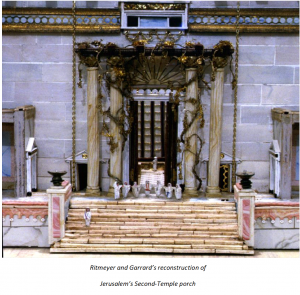
Today’s I am statement, I am the true vine, is for us an obscure Temple reference. What does a vine have to do with the Temple? The archæological architect, Leen Ritmeyer is a world authority on the Temple of Jesus’ time. On the basis of his research, he and a colleague designed and built a scale model of the second Temple Jesus knew. Supporting its porch are four columns. Wreathed up these columns and over the porch is a huge vine, wrought out of gold; the Golden Vine of the Temple.

This vine represented Israel whom God had planted in the Holy Land. Ps 80; Hos 5; Jer 2. It graced the doorway into the Holy of Holies. And pilgrims would bring offerings of golden leaves and clusters of golden grapes to add to the Temple vine’s splendour. In the Mishnah, we read whosoever gave a leaf, or a berry, or a cluster as a freewill-offering…brought it and [the priests] hung it there”. (Middot 3.8) So to return to this morning’s Gospel reading, when Jesus said I am the true vine, he was declaring that he superseded all this in his own person. He was effectively saying, By me, by this doorway, you enter God’s presence. I am the way.

Vines have a mind of their own. Watch them grow and you see creation at work before your eyes. Little tendrils stretch out quickly, looking for the next thing to grab onto. They set the direction of growth for the rest of the vine towards the light. Plants adapt to their environments like that. They adapt and belong – they give fruit, shade, beauty, variety, oxygen – they give life. So I find it a fascinating picture Jesus gives us of ourselves, the church, as the branches. It’s an image which speaks of amazing variety; an image of life-giving providence.

The vine growing in the soil is a picture of Jesus connecting us with the source of our being. It’s an organic, reciprocal image of a church community who can grow and spread where we’re needed in order to provide nourishment, refreshment, shade and beauty. There’s a wonderful purpose to it. Christ as the vine and we as the branches says that we are called to provide for anyone who needs our fruit.

Plants can be utterly different from each other – each specially adapted to its own particular environment. So how does this speak to us – St John’s, a branch of the true vine? In Adelaide terms, we’re an ancient parish – the second oldest – and we’ve seeded other parishes in our time – parishes, a school, St John’s Youth Services, our community store. And we’ve seen significant prunings too. The world around us has changed and we’ve adapted. And Jesus still calls us to bear much fruit. We’re the latest season of branches of the true vine, called to bear much fruit.

The golden vine of the Jerusalem Temple was a sign of God’s provision, and at the same time, an emblem of the people’s gratitude. It’s a very helpful image, this link between gratitude and generosity. It characterises people who know we are loved and blessed, and feel moved to respond with love and gratitude.

But how to respond to such a gift? In my weekly, I wrote about the work of St John’s Youth Services, which is a beautiful fruit of this branch of the vine. I also wrote about some related services that serve the poorest and most vulnerable in our community – homeless people; people escaping the poison of coercive control and violence; Aboriginal people in need – all on our doorstep, many with no safe place.

It’s time to ask if the fruit we’ve been producing until now is adapted to current needs. Are we bearing enough fruit – the right variety? Are we alive to specific needs; are we willing to be pruned; to have other branches grafted in with us, or to be grafted in different places ourselves? Are we called to something new? These are things we can only discern together through prayer and listening – openly and courageously. Do we increase the ministries we’re doing to meet increased need, or add something quite new? We in Parish Council await your suggestions. Amen.