We are a connected community

image_pdfimage_print

Rev’d Peter Balabanski

Michaelmas 2012 A & C: Kids: Angel Windows – connection

The message of our Gospel for the feast of Michael and all Angels is quite simple; tell people about Jesus, and call them to meet him. We saw this acted out right before our eyes where Philip found Nathanael and told him, We have found Jesus—the promised one. When Nathanael seemed doubtful, Philip said, Come and see. And he took him to meet Jesus. That’s today’s message. Tell people about Jesus, and encourage them to meet him.

Why? And what’s it got to do with Michael and all Angels? Angels are messengers: that’s what the name angel means. Philip brought a message to Nathanael, so by definition that made Philip an angel – a messenger. And as he called Nathanael to Jesus, that also made him an evangelist – something Jesus tells all Christians to be. We are to call people to belong, with us, to Jesus.

Who is this Jesus we are introducing people to? He’s the most important person we know; he’s our teacher; our example, our Redeemer and our Saviour. The Christian message is that telling people about Jesus is the same as telling them about God, the source of our being. And that, astonishingly, the source of our being chose to be born and live among us, die our death and rise from the dead, so he’s alive now.

Because Jesus was born and lived our life, died and rose again, we who know Jesus, and anyone we introduce to him, can connect with the source of our being at any point in our life – birth, times of joy, suffering, fulfilment, despair, hope, love, compassion, loneliness, need, fear – and we remain connected on beyond this life. That’s some connection. And when we tell of Jesus as our Redeemer and Saviour, we’re also talking about this connection with Jesus helping us to confront the power of things that attack and divide us: hatred, slavery, greed, apathy – and again, even death. That’s an extraordinary message to carry; it’s a great privilege to be called to carry this message – to join in the work of the Angels.

If people – all living creatures – are to be whole; to thrive; to grow, we need to be connected to the source of our being, like a plant in the soil and sunshine. It’s both a biological and a spiritual necessity. Throughout history, the messages that angels bring are all to do with connecting us with the source of our being – the source of all life and growth. The ancient Jewish sages wrote There is not a single blade of grass on earth below that does not have an angel in the heavens above that strikes it and says to it: ‘Grow!’ (Midrash Rabbah, Bereishit 10:6; Zohar, part I, 251a [on Gen 18.1])

We people of the book have developed several quirks over the millennia, and we have the joy of encountering plenty of them today. Some of the readings and hymns at Michaelmas can make us feel like tourists in an ancient, exotic world, untouched by the passage of time. As today’s tour guide amongst words and images that the OED labels obs, I want to focus on the centre of all the readings and hymns: our sense of connection with a greater reality than just ourselves – with the divine. I think you’ll agree that this calls for extraordinary language and imagery.

We travel in a realm of cosmology and imagery that lots of people in the developed world find alien; bewildering. What do we make of Daniel’s white-haired Ancient One enthroned in the heavenly court? Isn’t that precisely the picture of God that western thinkers have used to caricature the Church since the eighteenth century? Those same thinkers have also told us to see the cosmic battle in Revelation between Michael and Satan as nothing but an ancient metaphor for the struggle between good and evil.

It’s up to each one of us to choose whether we see these visions and images as literally real, or as metaphors for our connection with the source of our being. I don’t think it makes much difference which we choose. But if our experience of life is to have any depth, we need to venture into that connectedness, and also to respectfully explore both ancient and contemporary ways of naming and expressing it.

Christians believe that the fullest experience of that connected life is to be found in this community that Jesus called into being: the Church – a community where we can and should share our experiences of God’s messengers, and let those messages shape our lives.

One of our most important roles as connected people is to teach our children how to live connected, full, rich lives of belonging. Kindy teachers are experts in this. They get kids singing funny old songs together, playing together, making things together, co-operating and caring. These are time-tested ways in which we hand down our civilization – our belonging – to successive generations.

They are also significant ways we live out that connection as adults. How do we see that at work here? I see a community that learns and treasures the words and tunes of the hymns; I see people singing together; meeting together; praying together; rejoicing together; grieving together; running a community store together; gardening together; learning together, being a multi-generational community where we know each other’s families, children and grandchildren; founding / supporting Christian work like SJYS and the Magdalene outreaches: the list goes on.

I’m conscious that all these treasures we nurture and hand down are things that our secular world is increasingly reluctant to value or support. Our schools and university systems are less and less funded to pass on our history, our wisdom and our deepest values. So it falls to the Church to do this – as we have done in other dark ages. One of the most important jobs this parish has is handing on the legacy of spiritual connectedness that God has given this community. We are a connected community. We are built on the bedrock of God’s love for us. We experience that most perfectly in the love that unites us in Jesus Christ. When we introduce our friends to Jesus, as Philip did with Nathanael, we connect people with God’s love for them, and we offer to share the ways we experience that love in our lives. So go to it Angels!                                                                                                    Amen

Season of Creation: Cosmos Sunday

image_pdfimage_print

Rev’d Peter Balabanski

4C: Colossians 1 15-20

When I was nine years old, I persuaded my Dad to lay his camera on top of our ladder in the back yard one night and take a photo of the Southern Cross. He used slide film so projecting the picture, we’d see a bigger, closer Southern Cross. He set the camera to open the shutter automatically and take a time-exposure shot. That way, there’d be no finger shake, and the stars should come out clear and bright.

When I finally saw the slide, my first reaction was disappointment. The stars didn’t come out as points of light, but as short lines. I felt better when I was told they were lines because of the spinning of Earth. The other thing that struck me was that stars come in different colours. There are three bluish-white stars, a red one and an orange one. The pointers are blue too – and the nearest one is a double star. So I started to learn about hot and cool stars, young and old ones, and binary stars.

But my biggest surprise about the Southern Cross was to come many years later. Down the bottom of the Yorke Peninsula, you can still see the Milky Way very clearly. Looking at the Southern Cross one night, a friend got me to look not at the stars but at the spaces. Could I see the huge Spirit Emu with its head just below the cross – did I know that’s what Aboriginal people see?

I was thus introduced to a totally different perspective on the cosmos – how in the ancient dreaming, life on Earth is spiritually connected with the universe. That book I’ve been quoting by Bruce Pascoe is called Dark Emu. By calling his book by that name, he’s saying that he’s entrusting his readers with the perspective of the Aboriginal People – the perspective of a people whose life and culture has always been profoundly and consciously interwoven with Earth and Heaven – a people who see life where we don’t; where we just see emptiness.

This takes us again to the theme I’ve been emphasising throughout this year’s Season of Creation; the opposites – interconnection and alienation. I continue to discover more and more how the traditional life of Indigenous peoples is one of deep connection with the natural order and with the numinous – the spiritual dimension of life. There is no sharp dividing line between physical and spiritual life in traditional cultures. Everything is interconnected.

By contrast, our culture is becoming increasingly one of alienation; physical and spiritual alienation from the natural world, and from each other. I’ve said a couple of times now that this alienation is a working definition of sin. Its marker is spiritual blindness – whether wilful of born of ignorance; spiritual blindness, whose consequence is alienation from each other, from the created order, and from God. It leads to death; both our own death, and the death we are inflicting on more and more of non-human life. The result of this sin is that we are in crisis, and because of the influence we have over our environment, the whole created order is in crisis too.

So what do we do? How do we address this? On Friday, we saw the young people of the world rise up and demand change. Our children are frightened for their lives; they’re also angry at the obdurate stupidity – the wilful blindness – the greedy deafness – of those who claim the authority to run the world, yet who are allowing the destruction of nature for profit.

On Friday, for anyone with ears to hear, our children demanded something that our Christian faith teaches. They reminded us that the way to deal with the power of sin is repentance; turning around; turning from death to life; turning to follow the Way to life. Our children are calling us to turn to Life. That’s what repentance means.

You can quite reasonably ask me if I am saying this as a Christian teacher or just as a committed environmentalist. Am I just co-opting my faith to make it serve my greenie passions? Does anything in Scripture authorise Christian environmentalists to speak the way I’ve been doing over the past weeks? As it happens, we heard that very Scripture today. We just shared in the Colossians hymn. I picked out a few sentences from it in my weekly – they’re in bold print on the back of the pewsheet. Let’s consider the first three sentences. The first two say

In Christ all things in heaven and on earth were created.

All things have been created through him and for him.            v.16

So this hymn teaches that the natural order belongs to Christ alone.

The third sentence says – In him all things hold together.                 v.17

So this hymn also teaches that the interconnectedness of the natural order is the result of Christ’s agency and will. What these words say to me – Christ’s ownership of the natural order and his will to sustain it – these words tell me that a failure to care for the natural order is a failure to respect the will of Christ. This has practical spiritual consequences.

Standing by while the environment is destroyed has the effect of shutting others off from encountering God. Paul wrote in Rom 1.20, Ever since God created the world, his invisible qualities, both his eternal power and his divine nature, have been clearly seen; they are perceived in the things that God has made. As we look on, human civilization is destroying those very things. Vicky writes about this.

Experiencing the majesty of the natural world, in all its diversity and strangeness, its symbiosis and complexity, is becoming a rare and precious thing – the stuff of eco-tourism and World Heritage sites. Wild places are now packaged and marketed, to manage the tourist footprint. The velvety depth of the night sky unencumbered by artificial lights is now, for very many, a memory.   …

If Christ embodies and reveals the invisible God in and through the natural world, this means of revelation is also becoming increasingly rare and precious. How are future generations going to glimpse the numinous, except artificially, in pre-packaged portions? As we allow the diminishment of species and ecosystems, we diminish our ability – and the ability of future generations – to perceive the glory of God. This can no longer be peripheral to those who love Christ. See VSB,  Colossians: An Eco-Stoic Reading

On Friday, our children called us to action – to repentance and action. Today, our scriptures tell us they spoke the Truth in Christ. How are we, as a parish, going to respond?             Amen

Season of Creation: Storm Sunday

image_pdfimage_print

Rev’d Peter Balabanski

3C : Psalm 29

Have you ever been out in a huge storm? Were you unsafe? What or who was your greatest concern? Did you understand what was happening – were you mentally prepared? Do the children you know have any idea about surviving storms?

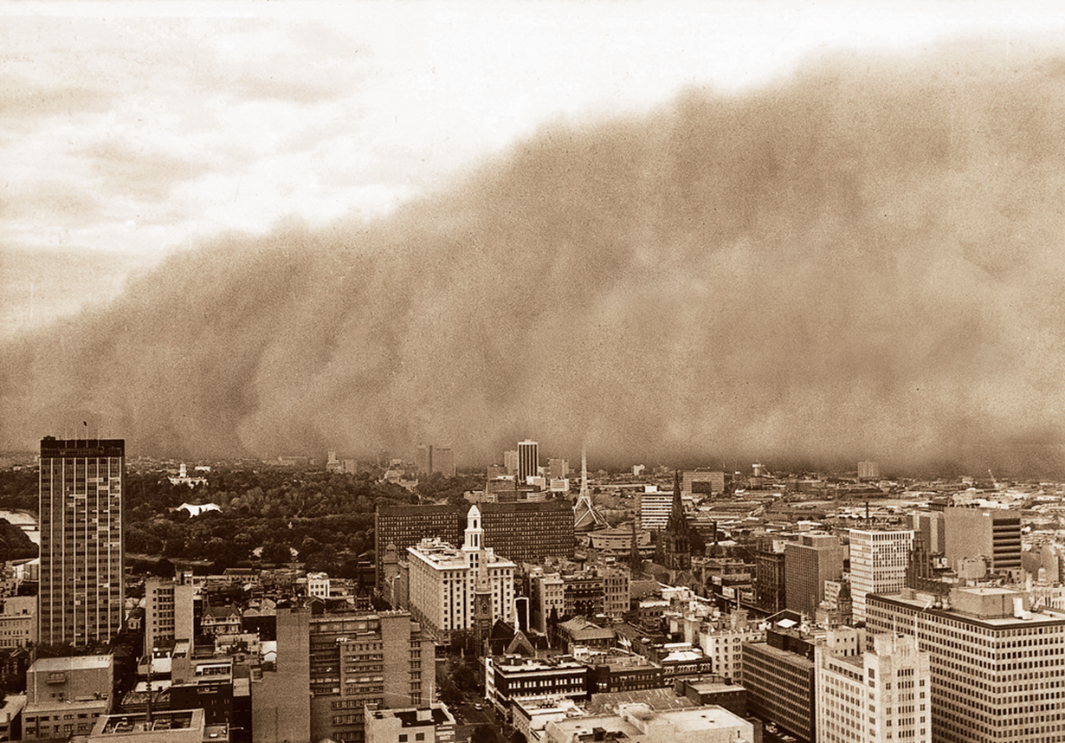
Look at this picture of a dust storm sweeping east across Melbourne; 8th Feb 1983. I vividly remember the moment when that dust storm hit. I was teaching at Footscray TAFE College. We had no warning of what was coming; within a matter of seconds, broad daylight outside suddenly turned into an eerie, howling reddish darkness. It was quite terrifying. I remember stories friends told me later – stories about frightened people they’d seen dropping to their knees in the street and tearfully praying. For some, it seemed clear that the end of the world had come.

Storms can provoke very deep feelings in us. They can do it even when we know the science – the way lightning and thunder are produced, where all that rain comes from, and how it sometimes transforms itself into devastating hail. We know all this. And the picture of that tremendous dust storm reminds us that we know the effect we have on the nature of some storms. If you combine land-clearing, over-grazing, old-style ploughing and deep drought then add a 100 km/h wind, like that afternoon in 1983, it can become something like a 500 km wide apocalypse.

We’re emotionally engaged with storms. They bring some of us to places of fear, depression, remorse, or for some of us, exultation – emotions often associated with our spiritual condition. For the ancients, a storm carried both the fear of destruction and the promise of blessing – the welcome rains after a long dry. So are we spiritually connected with God by storms, through awe, through fear, through hope and through the reminder that the vast energy of the universe is not under our control? Today, we’ve heard two different accounts of storms and faith, Ps 29 and the Gospel. Let’s look at the Psalm.

The psalmist calls the Heavens and the Earth to hear God’s voice in storms. We hear God’s voice in the noise, the power and the destructive force of storms, and we join the rest of creation in feeling fear, awe, regret, or maybe wild joy and hope in the greatness of God who promises us the blessing of a fertile Earth, softened at last by the rain.

Maybe we have difficulties connecting with something so primordial and alien to our perspective. We’re not the first. This Psalm was actually a re-writing of an ancient hymn to Baal, the Canaanite storm god. The original was likely to have been a prayer or song which – with the help of some money or gift – would appease the anger of this god of storms. The Psalmist’s rewrite has taken on this protection-racket and set out to free people from slavery to such a capricious system.

Instead, our psalmist proclaims the God whose grace doesn’t depend on people’s willingness to pay; our psalmist proclaims the God who’s not confined by our ideas of what’s invulnerable – neither the cedars of Lebanon nor even the Lebanon itself. Nor is God confined to blessing only those who are worthy (as Jesus says, God sends the rain on the just and the unjust Mt. 5:45). God is the one who, come what may, is going to bring about the ancient promise to Abram and Sarah; the promise that through them, God will bless all families of Earth. This is a promise of spiritual blessing, but ‘families of Earth’ is also explicitly physical – a blessing we experience through our senses; a blessing lived most truly when we are living in harmony with Earth.

One of the principles of Earth Bible scholarship is that Earth has a voice. Another Psalm, Psalm 19 describes that as a voice from the heavens which have no speech nor words … yet their voice goes out through all the Earth and their words to the end of the world. Ps 19.3-4       Rant alert. As we’ve acknowledged over the past two weeks, the world’s Indigenous peoples have always been attuned to that voice, living in harmony with Earth.

Indigenous peoples have indeed been that voice crying out against the injustice of colonization. And they are still crying out today; putting the Earth’s teaching about God’s grace into words that we could understand if we would only listen; warning us of the danger of our alienation from Earth. But we don’t listen. Far worse, we are still deliberately silencing Indigenous people’s voices; dividing to conquer, or making laws that imprison them in our alienation from the Land – their Land. Two weeks ago the Queensland government quietly extinguished the native title rights of the Wangan and Jagalingou people over their traditional lands. Shortly afterwards, the people received notices of trespass from a foreign mining company.

The dust storms that used to be so frequent taught us something, you’d hope. But you have to wonder. Will anyone hear Earth’s voice speaking through unheard-of early spring firestorms? Earth has a voice; Earth is speaking. But we are strangely deaf to warning voices. We are becoming steadily more alienated from plain reality. We must do better than a minister for drought and water resources who says talk of human-induced climate change is irrelevant to the fire conditions in Qld and NSW.

We’re into our third week now of exploring an ecological spirituality – how our spiritual life (our relationship with the divine) is deeply shaped by our relationship with nature; our exposure to nature and our attitude to nature. This Season of Creation is a time for us children of Earth to remember our first calling; that’s our God-given responsibility to manage, serve and care for the Earth community. Gen 1-3 This is reinforced in our calling as children of Abraham and Sarah to be God’s means of blessing to all families of Earth. Gen 12.1-3 Our actions are spiritually significant; the way we deal with our Earth family constitutes our service to God who calls us to care and to bless. And Earth has a voice in this. Today we’ve remembered hearing Earth’s voice in storms; remembered our feelings of bewilderment, isolation and helplessness, or maybe wild exultation. May our memories of hearing Earth’s voice remind us to keep listening carefully; listen and respond to God’s call; obediently, humbly, gratefully and with courage.  Amen

Season of Creation: Flora and Fauna Sunday

image_pdfimage_print

Rev’d Peter Balabanski

2C : Job 38, Ps 104, 1st Cor 1, Lk 12

As children, we grew up in something of a botanical menagerie. Mum filled the yards with trees, shrubs, bonsais, mosses and ground cover, and her glass house was stocked with an incredible variety of plants and cuttings taken from roadsides wherever we walked or drove. But even that wasn’t enough for her. She and a like-minded neighbour would lie in wait until any local house went on the market. The moment it was vacant, they’d launch a green-thumb commando raid, planting all manner of things in those gardens too. So our old street now looks utterly different from its surrounding streets; they look like desert wastes by comparison.

But that’s only the half of it; I also mentioned a menagerie. I remember as a ten year old conducting an audit of wildlife at our place. Twenty-two budgies, ten pigeons, four bantams, seven sleepy lizards and a big bluetongue, five guinea pigs, two turtles, a rabbit, a cat forever having kittens, a fat old Labrador, another budgie that sat on Mum’s shoulder everywhere she went, a ringtail possum that ate apples in our bedroom each night then tucked itself in with one or other of us at dawn, a bustling fish tank, and in my sister’s wardrobe, a rogue colony of silkworms. Our cousins out on the farm kept us in touch with our larger hairy brothers and sisters too. Mum has never altered her priorities to this day.

So flora and fauna Sunday is something of a homecoming for me. I love the close observation of wildlife that we just heard in Job and the Psalm; I resonate with the way the writers marvel at it all; particularly at the interconnection they see so clearly between wild creatures, flora, Earth, Sun and Moon, light and darkness. You’d think seeing that interconnection is a bit of a no-brainer really. But then you find that a book like The Secret Life of Trees comes as an utter revelation to people when its author Peter Wohlleben shows how an entire forest is connected by underground networks of fungus to form a massive, diverse, unified organism so mutually loving that it keeps even ringbarked trees alive.

Last week we began to consider the significance of connection as a major theme in the Season of Creation. And you may remember that its opposite, alienation, is a working definition of what the church calls sin; alienation from God and from each other. That’s why connection with each other, with interconnected wildlife and landscapes is so important. It makes the divine tangible; it connects us with God.

Today, on Flora and Fauna Sunday, the natural world presents us with herself; a miracle of interconnection, symbiosis, co-operation and balance; characteristics which are the deepest hallmarks of the natural order. Nature’s interconnection is far more profound than we imagine. By contrast, the competitive, winner-takes-all theories that we have imposed on the natural world have shackled our thinking about nature – as if they explain it entirely. Our theories have blinded us to the centrality of nature’s symbiosis. Of course, these theories have a great deal of truth to them; no-one should deny evolution. But they are nothing like complete enough.

Today I wonder if the doctrines of ‘natural selection’ and the ‘survival of the fittest’ – the so-called ‘cruelty of nature’ – have done something more than just skew our understanding of what is natural; done something more than prevent us from seeing the interconnection that sustains everything living. I wonder if our competition doctrines also shape the way we see ourselves; how we experience community.

Do native flora and fauna have something to teach us about community? What is an ecological perspective on society – an ecological spirituality? The key words seem to be relationship, symbiosis, interdependence, harmony – in a word, Nature.

A few of us met to think through the themes and priorities we wanted to cover in this year’s Season of Creation. Again and again, we found ourselves talking about the harmony of Indigenous peoples with nature. We are sitting helplessly now watching on as the Indigenous people and creatures of the Amazon rainforests are being burnt out of their homes by farmers, just as happened here over the first 150 years of European colonization; just as continues more subtly today. Eco-Rant alert.

I turn again to Bruce Pascoe’s remarkable book Dark Emu. He cites documents from European explorers and pioneers describing wide-scale Aboriginal agriculture and storages of surplus native grains and yams big enough to support permanent settlements of three or four thousand people between harvests. This was achieved through heavy, co-operative work, but without any need for irrigation, fertilizer or herbicides. Astoundingly, many witnesses have documented a vast, pan-continental ‘grain belt’ thousands of kilometres north of the Goyder line. (Map on p. 28) Our grazing animals ate it all to the ground and uprooted it virtually upon arrival. Their hooves compacted (and still compact) the Indigenous people’s carefully cultivated soil so these native food sources don’t grow there any more. And the original people and wild animals – the competition – disappeared behind euphemisms designed to cover up what we Christians don’t want to know about ourselves.

We don’t live in harmony with nature. We don’t spend time in it; we live, work and travel in climate-controlled silos that interact harmfully with nature. Our economically driven priorities won’t cherish anything we can’t put a money value on. We’re living a lifestyle that destroys anything we don’t value. It turns out we don’t value Mother Earth. We may as well say it plainly. We’re afraid of losing what we have, and so we fight and ignore and vote to protect it – never mind that it costs the Earth. That is true alienation; true sin, and we must repent of that sin.

Christians believe in repentance: it’s not grovelling and apologising, but turning from wrong and amending our ways. It’s easy to remember as a four step process.

1 Acknowledge wrongs we are doing, wrongs done in our name, and wrongs we benefit from. That’s what this sermon is trying to help us do regarding ecology.

2 Renounce those wrongs; stop them. That’s clearly imperative.

3 Turn and resolve before God and each other to try to repair the damage we have caused – seeking help from God and each other to do this, and helping others trying to do this. Students’ Global Climate Strike 20 Sept, 12.00 Victoria Square.

4 Getting on with the repair job, and so returning to a right relationship with our community, in this case the Earth community, and so with God.

We’re each at different stages on the way in this process. But what can we do? In notice time, Nicola will report on an organisation – the Foundation for Australia’s Most Endangered Species that we might choose to support as a community.

It’s one of many that we could choose from, but on this Flora and Fauna Sunday, it’s good to focus on rescuing members of our Earth family from extinction – family members dying out not because they’re a danger to us or to anything else, but just because we don’t seem to care if we never see them again.

That is true alienation; true sin, and we must repent of that sin.

I pray that our descendants will be able to know what Jesus is talking about today – what ravens and lilies and grasses are. I pray that our descendants will be consciously connected with all the wonders of life on Earth which reveal God’s eternal power and divine nature (Rom 1.19) so that they can come to know God.

Amen

Season of Creation: Ocean Sunday

image_pdfimage_print

Rev’d Peter Balabanski

1C: Job, Ps 104, Eph 1, Lk 5

I find the ocean to be a restorative wonder. When I sit on a cliff top or walk on a beach to the accompaniment of the slow, rolling crash of the waves, the way they roll towards me, ceaselessly pounding the shore, then thunder past, off into the distance; I don’t know how or why, but it has a life-giving effect on me. Even an hour at an ocean beach with its steady heart-beat of crashing waves can have a wonderful renewing effect, somehow connecting me with the Infinite.

The Pacific islanders we met in Fiji say that the ocean unites their islands – it doesn’t separate them; the ocean is what connects them. That’s different from our usual way of viewing large bodies of water as barriers or dangers to be negotiated.

I think I get it – that for island people, the ocean forms a connection, not a barrier. And for these people, the ocean doesn’t just supply their material needs; it’s a daily spiritual necessity. The Fijian Methodist minister, James Bhagwan told us how his daily prayer always has to be on the water. Swimming or paddling or simply floating, he finds his deepest connection with God in the gentle embrace, the rhythmic movement, and the playful, refreshing power of the ocean. I thought about James floating in prayer when I saw this morning’s reading from the book of Job. – that startling image – 38.8 the waters of the sea burst out from the womb. Just sit with that for a moment; the [primordial] waters of the sea burst out from the womb. Whose womb?

Let’s picture James; floating on that ocean which burst from the womb to envelop him in prayer. His prayer enacts something we need to know about; a connection with this vast life-bearing body of salt water and so with God – the embrace of the water around him connects with the prayer that wells up from within him. For James, ocean and prayer together embody connection with the source of our being; floating in prayer; a respite that takes us back to the safety of time before our birth. I wonder do salt-water baptisms recall the amniotic fluid of our physical birth?

Rev James helped me explore the spiritual significance of the ocean as the medium from which God called, and still calls life to emerge. And what life! I’ve always been lost in wonder at its teeming life; the giant kelp forests and seagrass fields, the lesser-known lungs of the world; and every shape, size and colour of living being, ranging from the bacteria around hot-water vents, vast shoals of tiny plankton and innumerable krill to the great whales – the largest animals ever to have lived.

I wanted to speak about the ocean today in that sense; the sense of its partnership with God both as a revelation of God’s majesty and of God’s creative delight in the diversity of life and in sustaining it through evolution. I wanted to speak of the ocean’s divinely inspired partnership with wind, sun and moon in the provision of a life-giving and life-sustaining biosphere of staggering power, beauty and diversity. I wanted us all to sit and watch David Attenborough shows together and simply bask and float in all these wonders. But there are other things needing saying too.

I didn’t want to give an environmentalist’s rant, but it’s part of the truth. I won’t make it long. The past week has brought more stories of our civilization’s abusive attitude to the ocean; two reports, one downgrading the Barrier Reef’s health, and another about its water quality,* and then the secretive handling of the Australian chief scientist’s report into prospective oil drilling in the Bight. They come on top of new studies of the ‘great Pacific garbage patch’, an island of plastic garbage almost the size of Queensland**; studies showing that micro-plastics are now measurable across the entire food chain – including us; reports of plastic bags mistakenly eaten by turtles, birds unwittingly feeding their babies bits of plastic so they starve to death; dolphins and whales snared in discarded fishing lines and nets drowning in senseless unseen agony; ocean acidification, oil disasters, gross over-fishing, super trawlers turning the seabed into a desert, all in addition to rising seas inundating island nations. The litany goes on, and we must not let it be silenced. We know where silence leads. The ocean is an expression of God’s love, and it’s being systematically killed as we watch.…There, that’s the end of the rant for now.

It is right that the ocean should supply us with food, just as Lake Galilee did for Jesus and his friends. But there is no place for the sort of abuse and greed that lies behind what I’ve just catalogued. There’s a thoughtful observation about today’s Gospel story by an Indonesian pastor in a village Bible study group. He said ‘In vv 6-7, we see a case of income equality and a spirit in Peter that shows no egotism. But if he hadn’t shared with his friends, his [boat] would have sunk and [he and] his friends would have had no fish.’

A woman in the group responded, ‘it seems to happen just the other way round in our society. For instance, foreign employers drain our fish and our properties for their own profit without sharing or making any adequate compensation.’ *** The people at the bottom of the heap know what’s going on, and we should listen to them.

One more story. I had the chance to read Bruce Pascoe’s book Dark Emu recently. Using the documentary evidence written by early explorers and settlers, he describes Aboriginal agriculture and river and ocean aquaculture before white settlement. In a chapter on aquaculture, he writes of their vast fish traps off the shore near Bermagui and Pambula (p. 70-1), and off Wellesley Island in the Gulf of Carpentaria (p. 90-1). But for me, the most astounding account is of a whaling partnership between the Yuin people (southern coastal NSW) and Orcas. (p. 71) There’d be a regular ceremony begun by a man on shore where the orcas responded by herding a whale inshore. The people would kill the whale, and then share it with other clans and with the orcas – who always got their favourite bit, the tongue. The partnership ended instantly and for ever when a European man shot the lead Orca.

If there’s a take-away message for Ocean Sunday, it’s partnership – connection. Our civilisation is alienated from nature, and so inevitably from God. And we are spreading our alienation – proclaiming our ‘standard of living’ as an end in itself, completely disconnected from its consequences for Nature.

This is a profoundly spiritual disease which we as God’s people are called to name and to challenge.

Alienation from God is a pretty good working definition of sin – living as though God is not there; as though God doesn’t notice what’s going on. And a telling sign of that alienation is our growing disconnection from the natural environment which sustains us and all life – our steady destruction of Earth.

I believe the call of Ocean Sunday is to reconnect with life’s Mother, the ocean;

to care for her and let her care for all the life she sustains;

to speak for her where her voice is being ignored;

to support and protect others who are speaking out, and to refuse to let them or ourselves be silenced.

Let’s commit to pray together with Rev James and today’s Psalmist

Let the sea roar, and all that fills it!                                                        Amen.